
mini teach-in: revolutionary mothering
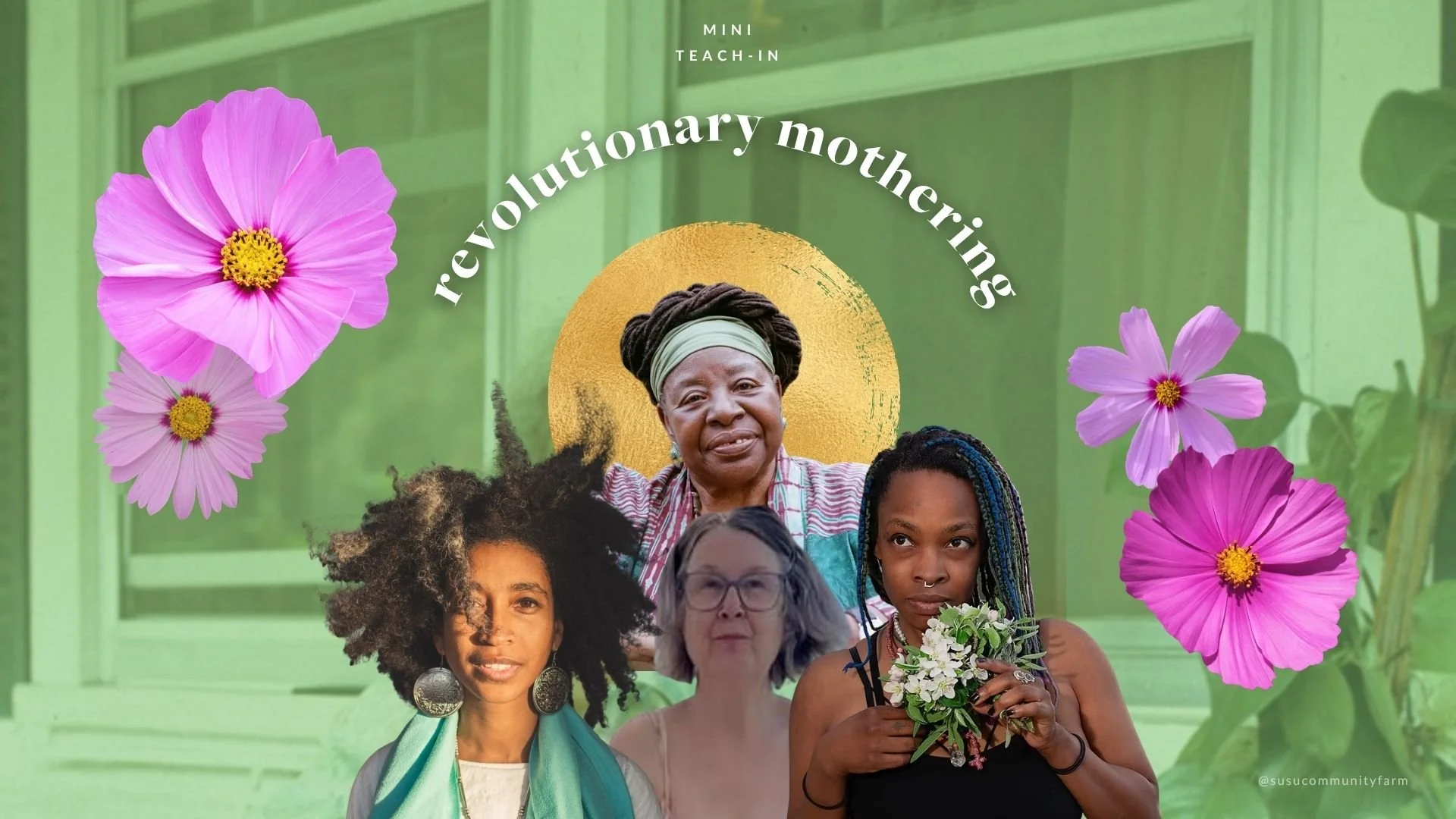
the anthology Revolutionary Mothering: Love on the Front Lines, edited by Alexis Pauline Gumbs, China Martens, and Mai'a Williams, reframes mothering as a political, cultural, and liberatory practice. we learn from them how to reframe the narrow definition of “mother” as a biological role and understand mothering as a set of actions, commitments, and relationships that are grounded in care, survival, resistance, and creation.
this body of work emerges from Black feminist, queer, and abolitionist traditions and builds on a lineage shaped by thinkers such as Loretta J. Ross, whose contributions situate mothering within reproductive justice. reproductive justice is a framework that asserts the right to have children, not have children, and to parent children in thriving communities. within this context, mothering is shaped by structural conditions, including racism, state violence, economic precarity, and environmental harm - and it also shapes structural conditions to deny oppressive technologies.
mothering beyond biology
mothering is not confined to those who give birth. we re-member ways of being like “othermothering,” kinship networks, and chosen family structures that have long existed in Black communities. these practices emerged as a survival response within histories of forced separation, enslavement, and systemic disruption of family structures. Black women and Black queer communities have always sustained collective care systems despite these conditions.
mothering, in this sense, is an ethic that includes feeding, teaching, protecting, witnessing, and holding space for growth. it is enacted by aunties, elders, organizers, neighbors, and community members who take responsibility for collective well-being. this expands the definition of who can mother and who is mothered.
love on the front lines
the subtitle of this anthology, “love on the front lines,” also helps us understand mothering as labor carried out in conditions of ongoing crisis. essays address incarceration, migration, disability, environmental injustice, and policing. mothering is framed as a practice of survival under systems that actively threaten Black life.
this aligns with Black feminist scholarship that positions care as political action. within the anthology, love is not passive or sentimental. it is described as disciplined, intentional, and often exhausting work. it includes boundary-setting, protection, and refusal. it also includes joy, creativity, and the transmission of cultural knowledge.
mothering as resistance
dominant narratives of motherhood have shaped by white, heteronormative, and capitalist ideals. these narratives define “good motherhood” through productivity, nuclear family structures, and compliance with state systems. contributors challenge these standards, arguing that they erase and criminalize black and marginalized forms of care.
revolutionary mothering disrupts and centers survival strategies developed under constraint, including informal economies, communal caregiving, and interdependence. it reframes what counts as “success” in parenting and caregiving, prioritizing safety, dignity, and cultural continuity over assimilation.
collective mothering and creation
creation is at the heart of mothering, not only in the sense of raising children but also in producing culture, movements, and futures. mothering is generative work that extends into organizing, art-making, teaching, and community-building.
this perspective aligns with Black feminist theories of social reproduction, which name that the labor of sustaining life is foundational to all other forms of production. revolutionary mothering recognizes this labor as skilled, strategic, and essential to collective survival.
implications for our lives
revolutionary mothering offers a framework for rethinking care in broader social and political contexts:
it challenges individualism by emphasizing interdependence.
it reframes caregiving as collective responsibility rather than private burden.
it positions care work as central to movement-building and social transformation.
it calls for structural change that supports caregiving, including access to housing, healthcare, and community safety.
for those not parenting children, the framework absolutely applies.
the question becomes:
how do you participate in sustaining life, protecting community, and creating conditions for growth?
please consider selecting “show my support by making this a recurring donation.”