
re-membering our relationship with time
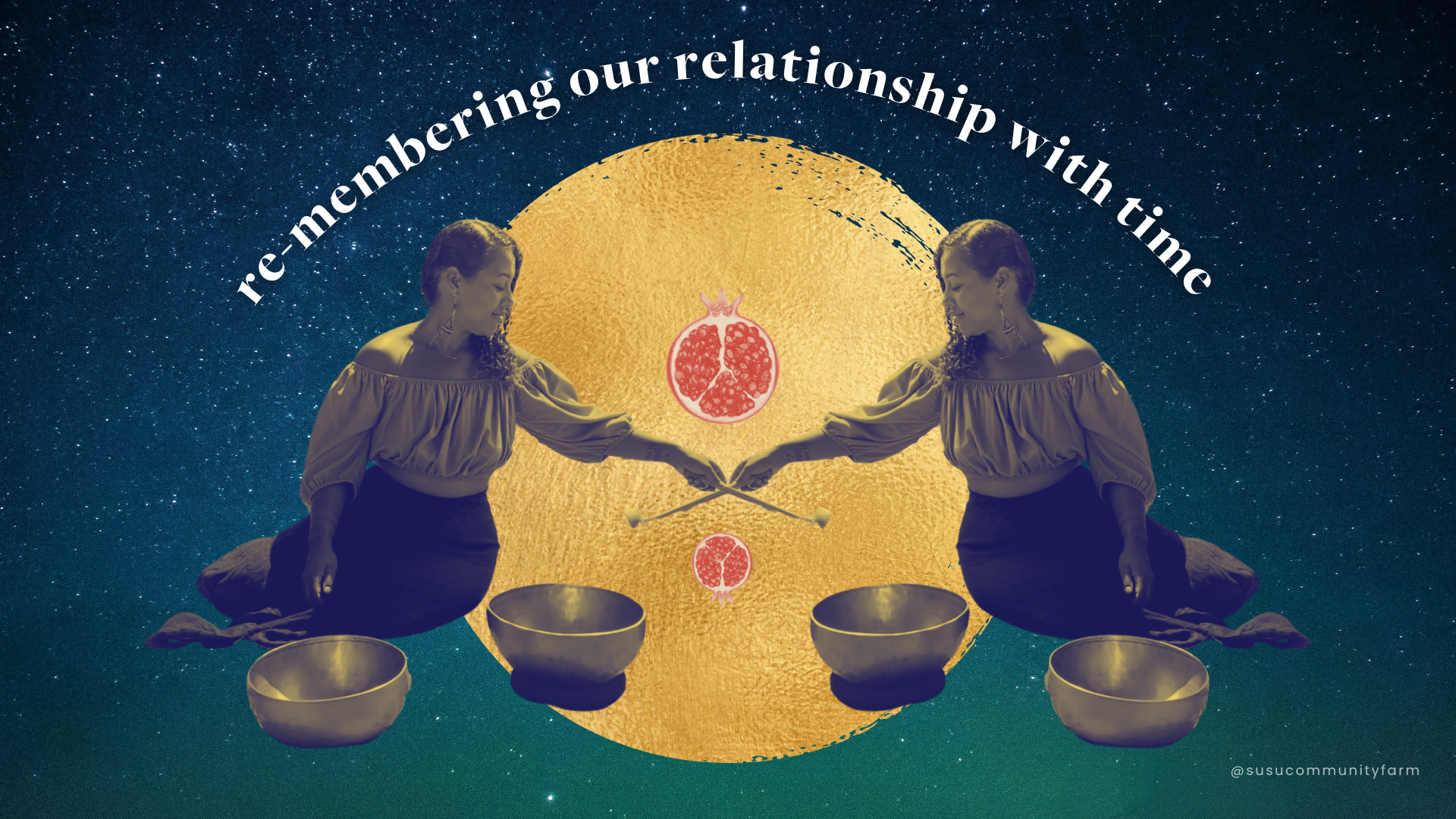
what if time as we have been taught and how we are living it is not as linear as it seems?
many of us were raised inside a relationship to time shaped by clocks, productivity, urgency, extraction, and endless forward motion. under capitalism and colonialism, time is treated as a resource and a linear trajectory.
Black, Indigenous, and diasporic traditions understand time differently - cyclical, layered, ancestral, ecological, recursive, and alive, to name a few. Black women have maintained parallel temporal systems through ritual, foodways, birth, death, song, agriculture, and spirituality. for example:
planting by moon phases
preparing specific foods for funerals or holy days
maintaining washing, quilting, or cooking gatherings tied to communal rhythms
singing songs that synchronized collective movement and memory
Black women often became custodians of what scholars call “living memory” through oral storytelling, praise traditions, mourning rituals, midwifery, herbalism, and church leadership, they have carried intergenerational knowledge when written archives either erased Black life or treated it as property.
at SUSU, we often speak about sanctuary, living archives, cultural transmission, and relationship with land. these ideas are deeply connected to alternative understandings of time.
the land itself interrupts industrial time. gathering around food, ritual, archives, songs, plants, grief, celebration, and seasonal cycles helps restore forms of temporal relationship that we have carried for generations despite disruption.
many Black women’s traditions also refused the idea that time automatically equals progress. mourning rituals, ancestor reverence, and recurring commemorations insist that unresolved violence continues shaping the present. this interrupts the Western idea that history is finished and left behind.
Black feminist scholar Christina Sharpe writes about “wake work” in In the Wake: On Blackness and Being. she says that Black life continues “in the wake” of slavery, meaning the past remains active in the present rather than completed historically - like weather systems we still live inside. time does not neatly separate historical violence from our lives today.
Saidiya Hartman says that official archives often fail to hold Black life fully. she shows how Black historical life often survives not through official documentation, but through fragments, gestures, repetition, and embodied practice. storytelling, imagination, oral history, and embodied memory become ways of re-membering what institutions erased.
Instead, ritual labor creates what some scholars describe as layered time:
the dead remain socially present,
the unborn remain ethically present,
and care work links generations simultaneously.
Alexis Pauline Gumbs explores oceanic time in Undrowned, through the lives of marine mammals to imagine ways of living beyond rigid capitalist pacing. breathing, migration, collective care, and adaptation are temporal teachings. time moves like tides.
especially in Southern Black traditions, Black women’s agricultural and herbal knowledge tied communities to ecological rhythms rather than abstract calendars. planting, harvesting, rootwork, preservation, medicinal gathering, and observing animal behavior all required attentiveness to seasonal and environmental time. this aligns closely with Indigenous scholarship on relational temporality, where time emerges through reciprocal relationships with land rather than mechanical measurement.
Indigenous scholars such as Robin Wall Kimmerer and Leanne Betasamosake Simpson challenge Western linear time through ecological relationships. seasonal cycles, reciprocity with land, migration patterns, ceremony, and stewardship create forms of knowledge through relationship. time is learned through attention to living systems.
science as physics complicates typical assumptions about time. contemporary theories in cosmology and quantum physics increasingly understand time as relational, nonlinear, or inseparable from movement and perception.
another example of this is grief as evidence that relationships exceed chronology. many people who grieve describe time slowing, collapsing, repeating, fragmenting, or becoming difficult to measure at all. neuroscience, psychology, Black studies, ritual studies, and Indigenous scholarship all point toward a similar insight: grief changes how humans perceive continuity, memory, embodiment, and presence. many traditions treat grief as a threshold state.
dreams intensify in memory and meaning.
coincidences unfold with repetition.
non-human beings signify visitation.
memories surface unexpectedly.
ancestors feel incredibly near.
together, these theories help us re-member that we belong to something larger than urgency and invite us to build a living Black archive on the land, in the body, and with each other, to carry wisdom forward (and backward and sideways through time).
reflection: what practices assist you to
move
re-member
care
work
rest
live
differently in relationship to time?
please consider selecting “show my support by making this a recurring donation.”