learning the living Black archive
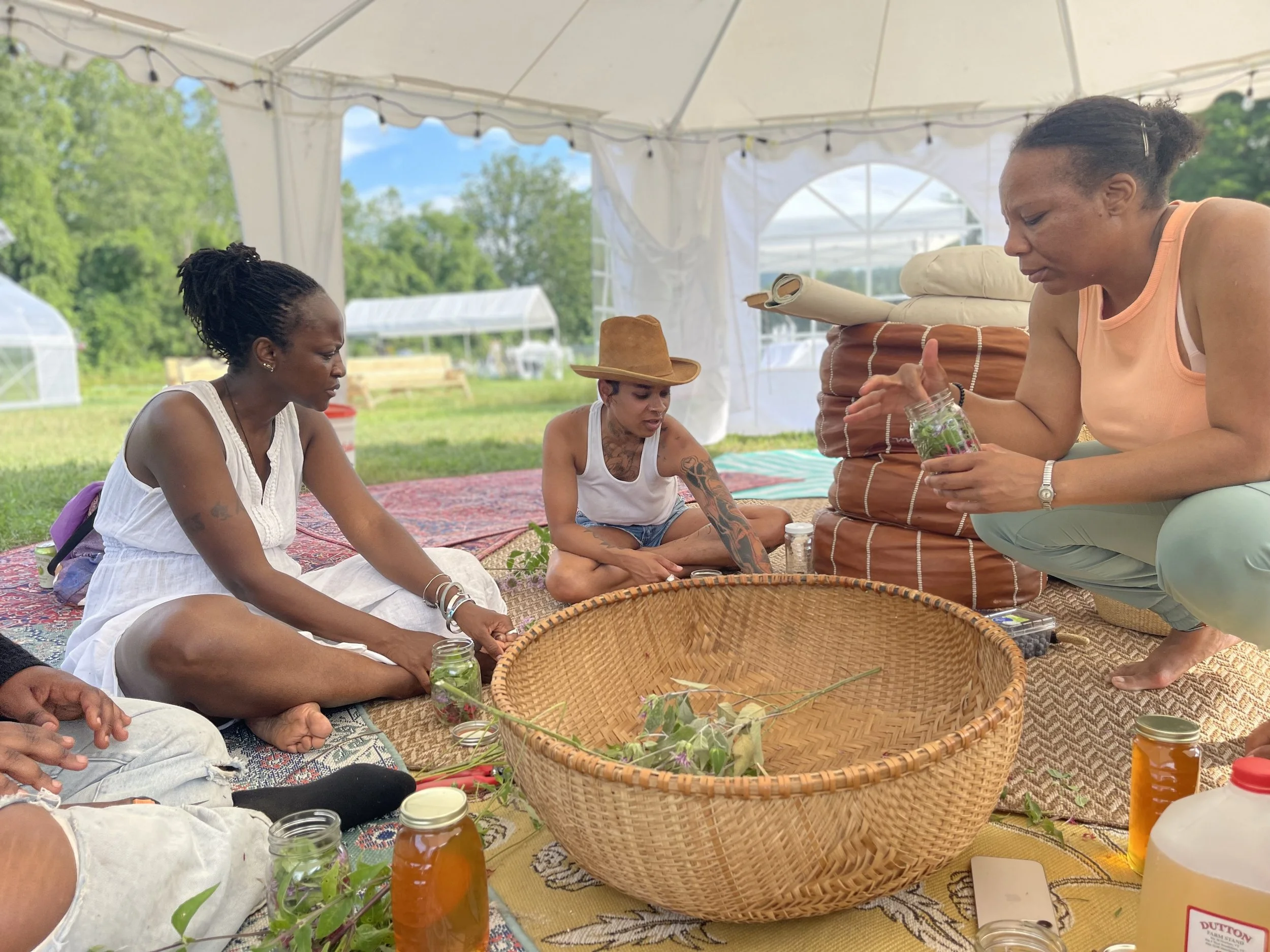
during Black stories month, we want to name SUSU and places like us as something called a “living Black archive.” this means we hold memories, rituals, and stories close in our minds and bodies and we document, repeat, and practice them.
at SUSU, we are creating a living, land based Black archival sanctuary, not housed in institutions that have historically erased or distorted our histories, but rooted in land, ritual, home, and embodied practice. our work preserves Black cultural memory through lived experience: through healing spaces, installation sites, medicine, foodways, somatics, and community gathering. these are the ways Black people have always carried knowledge when documentation was dangerous or denied.
in this portal into the living Black archive, we’ll share some resources, quotes, and open portals to the different ways to think about archive in relation to land, sanctuary, and practice.
Collier and Sutherland name core themes that shape Black archival practice, including care, embodiment, home, refusal, legibility, and repair. SUSU is built at the intersection of these themes. every offering we create is an intentional archival act, a method of cultural transmission that honors Black life as complex, relational, and alive.
archives are structured by power. Black archival practice begins by naming how historical recordkeeping has been shaped by inequality. the living Black archive becomes a necessary site of memory when historic records intentionally omit us.
Black archival practice reaches far beyond institutional collections. it includes the ways Black people have always preserved memory under conditions of violence and dispossession, through land tending, foodways, ritual, prayer, relationship, story, song, and the creation of sanctuary spaces where we could be human together.
“The production of historical narratives involves the uneven contribution of competing groups and individuals who have unequal access to the means for such production.”
— Michel-Rolph Trouillot, Silencing the Past: Power and the Production of History
“Memory is the way in which we keep the past alive.”
the living Black archive includes storytelling. our elders and knowledge keepers teach us that imagination and memory are also methods of repair. when records omit interior Black life, imagination is a method tethered to memory that lives in our bodies and life experience and helps us restore what has been systematically excluded from the record. at SUSU, we are participating in this method intentionally by adding stories and media into archival gaps as a rigorous practice and refusal of silence.
“I have attempted to tell an impossible story and to amplify the impossibility of its telling.”
— Saidiya Hartman, Venus in Two Acts
“The act of imagination is bound up with memory.”
— Toni Morrison, “The Site of Memory,” in Inventing the Truth
"Therefore the crucial distinction for me is not the difference between fact and fiction, but the distinction between fact and truth.”
— Toni Morrison
the living Black archive is not only about past. Christina Sharpe teaches us that wake work situates Black life within ongoing afterlives of our ancestors. at SUSU we insist on practices that interrupt and survive those conditions. we use care, ritual, and land practice as ways of living in the wake without surrendering to it - and our story is ongoing.
“In the wake, the past that is not past reappears, always, to rupture the present.”
“How do we memorialize an event that is still ongoing?”
“Wake work is a mode of inhabiting and rupturing this episteme with our known lived and un/imaginable lives.”
— Christina Sharpe, In the Wake: On Blackness and Being
homeplace and sanctuary are forms of resistance where the farm, the kitchen, the porch are counter-institutions. the living Black archive doesn’t need to be located in a single place, and it can move between places and times.
“Historically, African-American people believed that the construction of a homeplace, however fragile and tenuous, had a radical political dimension.”
— bell hooks, “Homeplace (a site of resistance),” in Yearning
our embodied repertoire conserves knowledge: seed saving, prayer, cultivation techniques, and rituals are archival systems. the living Black archive is experiential and it trains us to become ancestors.
“The repertoire enacts embodied memory: performances, gestures, orality, movement, dance, singing.”
— Diana Taylor, The Archive and the Repertoire
“We are practicing being ancestors.”
— Alexis Pauline Gumbs
land itself holds narrative in field lines, migration routes, and settlement patterns. we encode both struggle and creativity as spatial memory and forms of Black knowledge. the land SUSU is on is a living archive.
“Black matters are spatial matters.”
— Katherine McKittrick,Demonic Grounds
the living Black archive is a relational process. our impossible, possible futures are reciprocal, and stewarding land changes the steward. we dream and our dreams dream back at us.
“All that you touch You Change. All that you Change Changes you.”
— Octavia E. Butler, Parable of the Sower (1993)
“I dream a dream that dreams back at me”
— Toni Morrison, A Mercy
Black freedom farms like SUSU are cooperative land that bring political education, liberation, and collective survival as archival practice. SUSU offers healing retreats as a core archival transmission. retreats are spaces where people can slow down enough to listen to their bodies, their ancestors, and the land. our healing retreats are spaces where we bring our archival stories and memories to life.
“Black farmers have long used agriculture as a form of resistance.”
— Monica M. White, Freedom Farmers
“We are the ones we have been waiting for.”
— June Jordan
as a living Black archive, SUSU brings cultural survival, repair, and future making. we support Black-led infrastructure that restores dignity, belonging, and embodied memory, while offering practical, accessible pathways for healing, education, and economic sustainability. in a time of fragmentation, SUSU offers grounding. in a time of extraction, SUSU practices sovereignty. In a time of forgetting, SUSU ensures that Black histories, wisdom, and love remain alive and transmissible for generations to come.
archiving Black life is also future making. everything we do is in service of keeping our people, our stories, and our wisdom alive.
set an intention for how you will
make
reflect
support
become
the living Black archive
please consider selecting “show my support by making this a recurring donation.”